
Ielts task 1: Pie chart
WRITE DESCRIPTION HERE
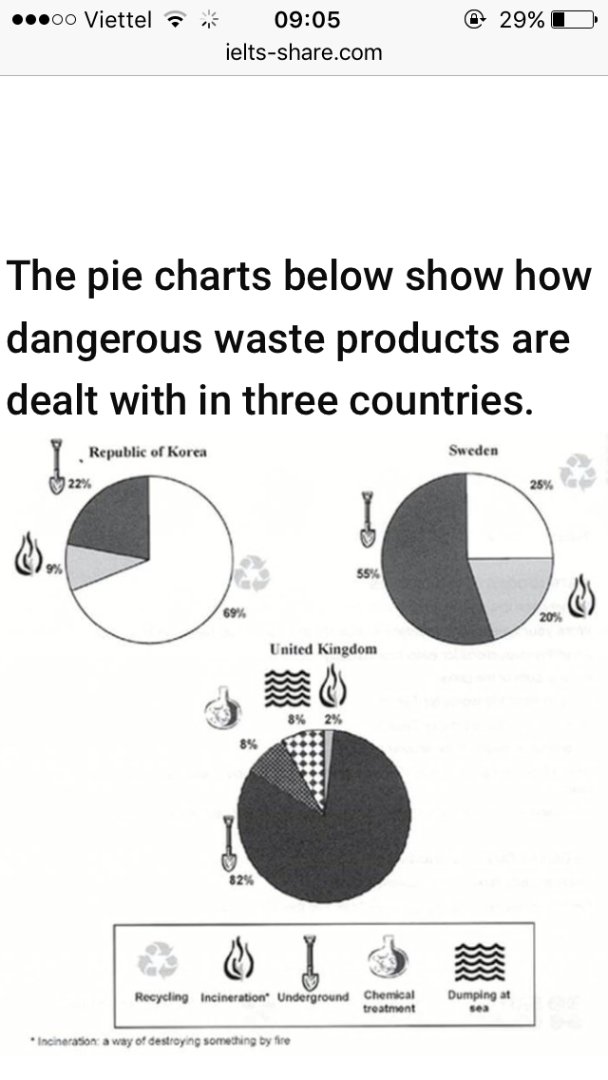
The pie chart illustrates the treating methods of toxic waste in the Republic of Korea, Sweden and the United Kingdom.
Overall, while underground is the most popular method of treating dangerous waste in Sweden and the United Kingdom, the most significant proportion of waste is treated by recycling in the Republic of Korea.
As can be seen from the chart, over three quarters of waste products in the UK was dealt by underground, compared to 55% in Sweden and 22% in the Republic of Korea. Recycling is the most popular types of waste treatment used in the Repulic of Korea with roughly 70%, whereas just a quarter in Sweden and there is no recycling process in the UK. Incineration accounted for 20% of waste treated in Sweden, while there is a mere proportion of waste products dealt by this measure in the Republic of Korea and the UK, just 9% and 2% respectively. The remaining 16% of waste is equally treated by chemical treatment and dumpinh at sea in the UK, and these two kinds of treatment do not appear in the Republic of Korea and Sweden.
Top answer
The pie char ts illustrat e the treating methods of treating toxic waste in the Republic of Korea, Sweden and the United Kingdom. Overall, while burying waste underground is the most popular common method of treating dangerous waste in Sweden and the United Kingdom, the most significant proportion of toxic waste is treated by recycling in the Republic of Korea is recycled . As can be seen from the chart, over three quarters of waste products in the UK was dealt by are buried underground, compared to 55% in Sweden and 22% in the Republic of Korea.
- The pie char ts illustrat e the treating methods of treating toxic waste in the Republic of Korea, Sweden and the United Kingdom.
- Overall, while burying waste underground is the most popular common method of treating dangerous waste in Sweden and the United Kingdom, the most significant proportion of toxic waste is treated by recycling in the Republic of Korea is recycled .
- As can be seen from the chart, over three quarters of waste products in the UK was dealt by are buried underground, compared to 55% in Sweden and 22% in the Republic of Korea.
- Recycling is the most popular common typ e of waste treatment used in the Repu b lic of Korea with roughly 70%, whereas just a quarter of hazardous waste in Sweden is recycled, and there is no recycling process in the UK.
- Incineration accounted for 20% of waste treated in Sweden, while there is a mere proportion 9% of waste products dealt by this measure produced in the Republic of Korea is disposed of by incineration.
Get the Weekly English Kit 📬
New words, one handy idiom, and a 2-minute quiz — delivered to your inbox to keep your streak alive.
The pie charts illustrate the treating methods of treating toxic waste in the Republic of Korea, Sweden and the United Kingdom.
Overall, while burying waste
 0
0 Related Questions