
IELTS TASK 1: Bar chart and table (The number and percentage of international students in English-speaking countries)
The bar chart and table show information about students from abroad studying in four English-speaking countries in 2004 and 2012. Summarise the information by selecting and reporting the main features, and make comparisons where relevant. Write at least 150 words.
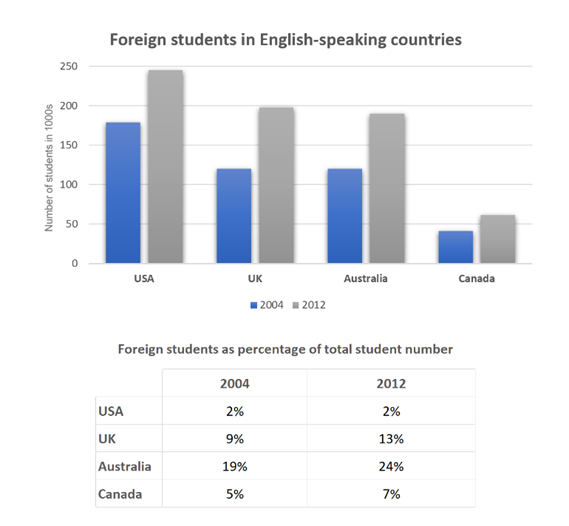
The bar chart plots the number of foreign students in countries that have English as their official language in 2004 and 2012. The countries are the USA, UK, Australia, and Canada. Below the bar chart is a table which compares the percentage of foreign students in 4 countries in both years.
Overall, the number of students studying abroad in those 4 countries increased moderately, the percentage of whom either rose or remained relatively the same in 2012.
In 2004, the USA was the country that had the highest number of international students at around 175 thousand, which rose to almost 250 thousand in 2012. However, international students only accounted for 2% of the total number of students in the USA in both years. In contrast, the number of foreign students in Australia was the same as in the UK in 2004 and slightly lower in 2012, the percentage of whom made up almost a quarter of the total students. Canada had the lowest number of international students, at around 4o thousand in 2004 and above 50 thousand in 2012. International students comprised 5% to 7% of the total students in Canada.
Top answer
The bar chart plots the number of foreign students in the USA, UK, Australia, and Canada countries that have English as their official language in 2004 and 2012. The countries are the USA, UK, Australia, and Canada. (You do not need two sentences.
- The bar chart plots the number of foreign students in the USA, UK, Australia, and Canada countries that have English as their official language in 2004 and 2012.
- The countries are the USA, UK, Australia, and Canada.
- (You do not need two sentences.
- Besides there are many other countries that have English as their official language, so your first sentence is not accurate.
- Be very precise in Task 1.
Get the Weekly English Kit 📬
New words, one handy idiom, and a 2-minute quiz — delivered to your inbox to keep your streak alive.
The bar chart plots the number of foreign students in the USA, UK, Australia, and Canada countries that have English as their official language in 2004 and 2012. The countries are the USA, UK, Australia, and Canada. (You do not need two sentences. Besides there are many other countries that have English as their official lang
 0
0 Related Questions