
0
AlpheccaStars Posted 15 years ago
Linguistics Studies
Future Tense
Hi All;
There was a recent thread that digressed a bit into incivility on the subject "Future Tense".
Some posters claimed that English had no future tense, and others were somewhat astonished by this.
I think both viewpoints are correct; it depends on the definition of "tense."
First of all, everyone (I hope) will agree that Latin has a future tense. I present this evidence:
FUTURE TENSE, Active voice
Latin uses two sets of endings to show future tense. These depend on the conjugation of the verb.
FIRST CONJUGATION VERBS
amo (amare)
Both drop the -re from the second pr. part to form the root.
amaBO I will love
amaBIS you will love
amaBIT he will love
amaBIMUS we will love
amaBITIS y’all will love
amaBUNT they will love
The Latin verb is inflected, so the verb itself, with no auxiliary, can convey not only the time frame, but also the number and subject.
Back to the future.
You see that there is a translation in English, but no inflections. So, if tense strictly equates to inflection of the verb, English has no such thing as "future tense."
On the other hand, in most every ESL course materials there will be a summary of verb forms such as this:
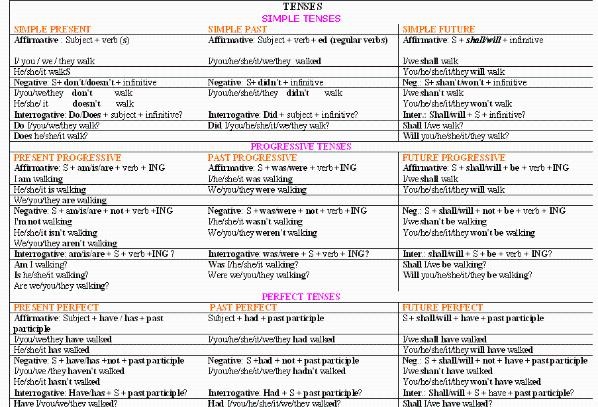
Note the Tense headings of Simple Present, Simple Past, Simple Future. I have used similar charts a lot in summarizing English tenses (oops, verb forms). It seems so logical and systematic! Learners could care less about Latin grammar, so books abuse the technicalities and just name the tenses sensibly and practically, to make learning easier.
If we post (outside of the LinguisticsForum) that English has no future, that would sound very strange, even absurd, to the majority of our audience.
There was a recent thread that digressed a bit into incivility on the subject "Future Tense".
Some posters claimed that English had no future tense, and others were somewhat astonished by this.
I think both viewpoints are correct; it depends on the definition of "tense."
First of all, everyone (I hope) will agree that Latin has a future tense. I present this evidence:
FUTURE TENSE, Active voice
Latin uses two sets of endings to show future tense. These depend on the conjugation of the verb.
FIRST CONJUGATION VERBS
amo (amare)
Both drop the -re from the second pr. part to form the root.
amaBO I will love
amaBIS you will love
amaBIT he will love
amaBIMUS we will love
amaBITIS y’all will love
amaBUNT they will love
The Latin verb is inflected, so the verb itself, with no auxiliary, can convey not only the time frame, but also the number and subject.
Back to the future.
You see that there is a translation in English, but no inflections. So, if tense strictly equates to inflection of the verb, English has no such thing as "future tense."
On the other hand, in most every ESL course materials there will be a summary of verb forms such as this:
Note the Tense headings of Simple Present, Simple Past, Simple Future. I have used similar charts a lot in summarizing English tenses (oops, verb forms). It seems so logical and systematic! Learners could care less about Latin grammar, so books abuse the technicalities and just name the tenses sensibly and practically, to make learning easier.
If we post (outside of the LinguisticsForum) that English has no future, that would sound very strange, even absurd, to the majority of our audience.
Top answer
They who dare can only talk about the future in the will of ***, in otherwards we know nothing about the future unless *** told us in a prophetical way, However, we don't know our personal physical future. So is future tense dangerous! yes, if, your claiming you know whats going to happen.
- They who dare can only talk about the future in the will of ***, in otherwards we know nothing about the future unless *** told us in a prophetical way, However, we don't know our personal physical future.
- So is future tense dangerous!
- yes, if, your claiming you know whats going to happen.
- Oh Dolly!
- I love you sometimes, one day at a time sweet Jesus that's all im asking for now............
Get the Weekly English Kit 📬
New words, one handy idiom, and a 2-minute quiz — delivered to your inbox to keep your streak alive.
24 Answers
0
They who dare can only talk about the future in the will of ***, in otherwards we know nothing about the future unless *** told us in a prophetical way, However, we don't know our personal physical future.
So is future tense dangerous! yes, if, your claiming you know whats going to happen.
Oh Dolly! I love you sometimes, one day at a time sweet Jesus that's all im asking for now.
So is future tense dangerous! yes, if, your claiming you know whats going to happen.
Oh Dolly! I love you sometimes, one day at a time sweet Jesus that's all im asking for now.
 0
00
It certainly confuses people when linguists say that English has no future tense as they think they mean that English has no means of talking about the future. Linguists have dug themselves a huge hole by insisting that a word has a narrower meaning than that used by the general populace. When I was at school and learning French and Latin we had simple tenses and compound tenses; now linguists ins
00
Woah woah woah!
@Forbes the 'no future tense' thing is an English teacher idea. Linguists know all languages have all tenses.
And I agree with your final statement. That's why I was so surprised by the insistence of such in the thread mentioned above.
@Forbes the 'no future tense' thing is an English teacher idea. Linguists know all languages have all tenses.
And I agree with your final statement. That's why I was so surprised by the insistence of such in the thread mentioned above.
00
I am not convinced it is language teachers who spread the idea that English has no future tense.
We can start off by saying that there was a time when "grammarians" tried to squeeze English grammar into a box labelled "Latin". Because Latin is not significantly different from English in its basic framework it did not fit too badly even if it needed a bit of banging in. There came a point
We can start off by saying that there was a time when "grammarians" tried to squeeze English grammar into a box labelled "Latin". Because Latin is not significantly different from English in its basic framework it did not fit too badly even if it needed a bit of banging in. There came a point
00
I think a "tense" is just the "time" a verb refers to. What really makes a difference is: with or without any context?
1. If context matters in the definition of "tense", then every language has present, past, and future tenses (or at least I think so).
2. If context doesn't matter, then only verbs matter. In this case, if the verb can express future t
1. If context matters in the definition of "tense", then every language has present, past, and future tenses (or at least I think so).
2. If context doesn't matter, then only verbs matter. In this case, if the verb can express future t
00
@Forbes and @Kooyeen, you've both hit on some very good points and rather than discuss those yet, let me ask you this instead:
What exactly is tense (kooyeen you're close)?
If you were to purely define tense by itself, not as some general idea, and not just as a synonym for time, how would you describe it? When you say something is present, past, or future tense what do you mean
What exactly is tense (kooyeen you're close)?
If you were to purely define tense by itself, not as some general idea, and not just as a synonym for time, how would you describe it? When you say something is present, past, or future tense what do you mean
00
I could think up some definitions of "tense" or find some by Googling and copy and paste them, but to do so would not advance my argument since it does not depend on what "tense" means, but rather on the use of word being restricted. Many people have an idea of what a word signifies even if they have never considered precisely what it may mean. If I were to meet one of my school contemporaries (on
00
KooyeenLast year I kill man. Man die. Police look for me for many months. Yesterday police find me. I now in jail.Ah Kooyeen, This sounds like a script from an old Tarzan movie. Of course, Tarzan would have an honorable story, not a criminal one. He would also avoid the use of copula (at least in the present!) Me Tarzan, King of Jungle. Me strong and fas
00
After I posted, I realized that I might have said something that could be technically inaccurate, because I remember reading that "tense" is not only about "time", but also about "aspect" and maybe something else.
It's written on Wikipedia: "In languages which have tense, it is usually indicated by a verb or a modal verb, often combined with categories such as aspect, mood, and voice."
It's written on Wikipedia: "In languages which have tense, it is usually indicated by a verb or a modal verb, often combined with categories such as aspect, mood, and voice."
00
ForbesI could think up some definitions of "tense" or find some by Googling and copy and paste them, but to do so would not advance my argument since it does not depend on what "tense" means, but rather on the use of word being restricted. Many people have an idea of what a word signifies even if they have never considered precisely what it may mean. If I were to meet one
0 Related Questions