
DIFFERENT METHODS OF WASTE TREATMENT
Please give me some feedback on the quesion in the image 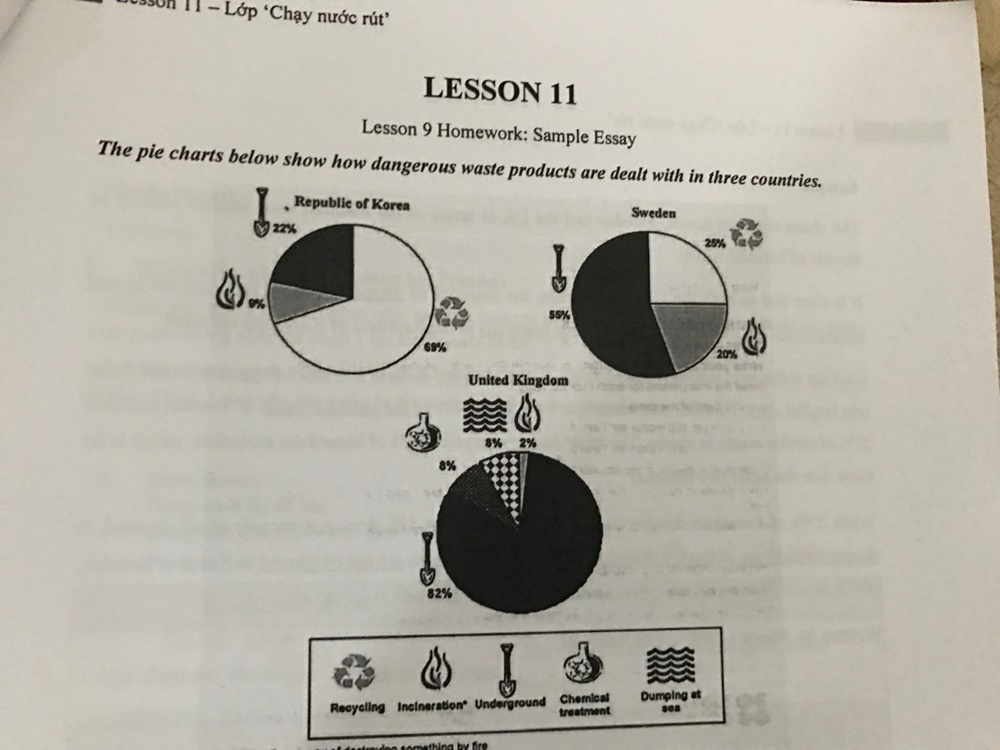
below.
My answer:
The pie charts show different methods of hazardous waste treatment in the Republic of Korea, Sweden, and the UK.
Overall, most dangerous waste in Korea is recycled, while landfill is the most common form of organized waste disposal in the other nations.
In detail, Korea recycles nearly 70% of its waste, whereas the UK does not use this way and in Sweden 25% of the waste is reused. In fact, the UK and Sweden are more in favour of the choice of landfill to deal with 82% and 55% of harmful waste products respectively. Meanwhile, the percentage of the waste buried underground in Korea is just over 20%.
As regards incineration method, Sweden incinerates more of its waste than Korea and the UK, with the figures being 20%, 9%, and 2% respectively. It is noticeable that in addtion to the above-mentioned methods, the UK uses two more ways, namely chemical treatment and dumping into the sea, to treat 8% of their hazardous waste products.
Top answer
The pie charts show different methods of hazardous waste treatment in the Republic of Korea, Sweden, and the UK. Overall, most dangerous waste in Korea is recycled, while landfill is the most common form of organized waste disposal in the other nations. In detail, Korea recycles nearly 70% of its waste, whereas the UK does not use this way and in Sweden 25% of the waste is reused.
- The pie charts show different methods of hazardous waste treatment in the Republic of Korea, Sweden, and the UK.
- Overall, most dangerous waste in Korea is recycled, while landfill is the most common form of organized waste disposal in the other nations.
- In detail, Korea recycles nearly 70% of its waste, whereas the UK does not use this way and in Sweden 25% of the waste is reused.
- In fact, the UK and Sweden are more in favour of the choice of landfill to deal with 82% and 55% of harmful waste products respectively.
- Meanwhile, the percentage of the waste buried underground in Korea is just over 20%.
Get the Weekly English Kit 📬
New words, one handy idiom, and a 2-minute quiz — delivered to your inbox to keep your streak alive.
The pie charts show different methods of hazardous waste treatment in the Republic of Korea, Sweden, and the UK.
Overall, most dangerous waste in Korea is recycled, while landfill is the most common form of organized waste disposal in the other nations.
In detail, Korea recycles nearly 70% of its waste, whereas the UK does not use this way and in Sweden 25% of the waste
 0
0 Related Questions