
0
Paul Evdokimov Posted 10 years ago
Grammar
Defining/non-defining clause
Hi there,
Can anybody explain the author's distinction of 'defining' in the following sentences? Note that the sentences are not situated in any context - there supposed to be no reader's prior knowledge of either 'the singer' or 'the plans for tax reform'.
1.The singer, who was recovering from flu, had to cancel her concert. (considered non-defining by the author)
2. The minister talked about the plans for tax reform that he will reveal next month. (considered defining by the author)
Why is the singer who had to cancel her concert is 'more definite' than the plans for tax reform which will be revealed next month?
Thanks for your comments.
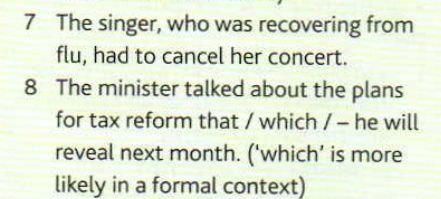
Can anybody explain the author's distinction of 'defining' in the following sentences? Note that the sentences are not situated in any context - there supposed to be no reader's prior knowledge of either 'the singer' or 'the plans for tax reform'.
1.The singer, who was recovering from flu, had to cancel her concert. (considered non-defining by the author)
2. The minister talked about the plans for tax reform that he will reveal next month. (considered defining by the author)
Why is the singer who had to cancel her concert is 'more definite' than the plans for tax reform which will be revealed next month?
Thanks for your comments.
Top answer
Paul Evdokimov Why is the singer who had to cancel her concert is 'more definite' than the plans for tax reform which will be revealed next month? It isn't. In the first of your sentences, 'the' defines the singer - she has presumably been mentioned before.
- Paul Evdokimov Why is the singer who had to cancel her concert is 'more definite' than the plans for tax reform which will be revealed next month?
- It isn't.
- In the first of your sentences, 'the' defines the singer - she has presumably been mentioned before.
- The relative clause, within commas (which function almost as brackets), tells us a little more about her.
- In the second sentence, the relative clause defines the particular plans that are to be revealed.
Get the Weekly English Kit 📬
New words, one handy idiom, and a 2-minute quiz — delivered to your inbox to keep your streak alive.
10 Answers
0
Paul EvdokimovWhy is the singer who had to cancel her concert is 'more definite' than the plans for tax reform which will be revealed next month?It isn't.
In the first of your sentences, 'the' defines the singer - she has presumably been mentioned before. The relative clause, within commas (which function almost as brackets), tells us a little more a
 0
00
fivejedjonIt isn't.I thus conclude that both the subject of the first sentence and the object of the second should be treated equally in terms of the type of the corresponding relative clauses.
fivejedjonIn the first of your sentences, 'the' defines the singer - she has presumably been mentioned before.No she hasn
00
Paul EvdokimovLet me reiterate that 'the sentences are not situated in any context'. They are merely the suggested answers to the 'rewrite' exercise (the original task below). Is it defining or non-defining?That sentence cannot exist without context. If t is just arbitrarily placed as a test exercise, then we must assume the context. The relative clause withi
00
fivejedjonIn the first one the writer had already defined 'singer. In the second, the writer wished to define 'plans'.
fivejedjonThat sentence cannot exist without context. If t is just arbitrarily placed as a test exercise, then we must assume the context.fivejedjon, we've never come so close to the point!
00
0
Paul Evdokimovwhat made the author treat the first relative clause as non-defining whereas the second one as defining?The clues given in parentheses.
The first one is a toss-up. Is it the singer who has flu as opposed to another singer who doesn't have flu? If so, it's defining. The singer who was recovering from flu had to cancel her concert.
00
CJ, thanks. That's exactly what I was getting at and asking about. I wonder why the author who considers 'that' to be an acceptable relative pronoun in non-defining relative clauses (see below)
00
fivejedjonIf you skip the commas, that's the end of the conversation.fivejedjon, don't get so easily offended, please. I'm just trying to stick to the point, which is not my punctuation but the author's.
00
Paul Evdokimov I wonder why the author who considers 'that' to be an acceptable relative pronoun in non-defining relative clauses (see below)I don't believe he really thinks that. It's just that the book isn't as good as it could be. Some of the presentation seems inept. It requires a live teacher to point out the flaws in the presentation and steer the st
00
I am not at all offended, but one of the defining (!) features of relative clauses in writing is commas. You can't just ignore them.
0 Related Questions