
Could you review and give me grammar on how to use ratio in the last sentence.
My essay:
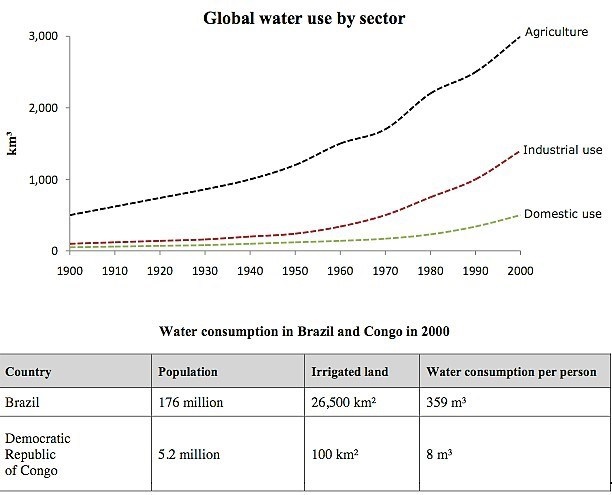
The charts compare the amount of water used for agriculture, industry, and homes around the world, and water use in Brazil and the Democratic Republic of the Congo.
Overall, worldwide water usage increased gradually from 1900 to 2000, and the agriculture sector used the largest amount of water. We can see that water consumption was considerably higher in Brazil than in the Congo.
In 1900, around 500km3 of water was used by agriculture while industry and domestic consumed a much smaller amount of water, both under 100 km3. With an increase of almost 2,500 km3, agricultural water use went up dramatically to around 3,000 km3 in 2000, compared to 1,300 km3 of industrial water use and only 500 km3 of water used for homes.
In 2000, the population in Brazil was 25 times higher than in the Congo, while the irrigated land ratio of Brazil and the Congo is 265 times. As a result, a person in Brazil consumed a much larger amount of water, at 359 m3, compared to 8 m3 in the Congo.
Would you be kind enough to guide me how to describe "ratio" in my last paragraph, please?
Top answer
The charts (Neither of these two figures is a chart. There are bar charts, pie charts, organization charts, eye charts and flow charts. None of these is shown.
- The charts (Neither of these two figures is a chart.
- There are bar charts, pie charts, organization charts, eye charts and flow charts.
- None of these is shown.
- ) compare the amount of water used for agriculture, industry, and homes around the world, and water use in Brazil and the Democratic Republic of the Congo.
- (Besides incorrectly naming the figures, you did not mention the time span, or time point for either one.
Get the Weekly English Kit 📬
New words, one handy idiom, and a 2-minute quiz — delivered to your inbox to keep your streak alive.
The charts (Neither of these two figures is a chart. There are bar charts, pie charts, organization charts, eye charts and flow charts. None of these is shown. Use correct names for the figures.) compare the amount of water used for agriculture, industry, and homes around the world, and water use in Brazil and the Democratic Republic of the
 0
0DatLeWould you be kind enough to guide me how to describe "ratio" in my last paragraph, please?
Ratio:
It is not described in my advice because few students use it in essays. A ratio is expressed by two numbers - a:b. It represents the relative numbers of two different items. Ratios have no units of measure, and they are u
00 Related Questions