
Could you please review ielts writing task 1 essay
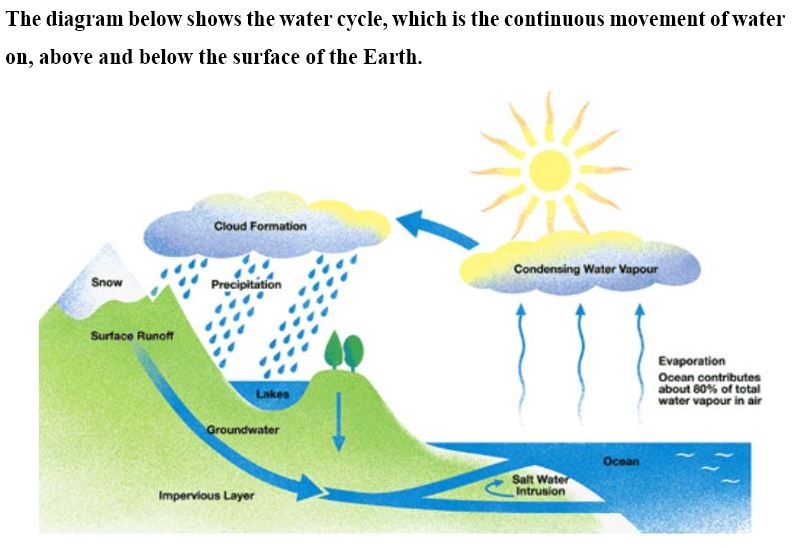
The picture illustrates the natural process which is called water cycle. The process is the movement of water from ocean to air to land.
Overall, there are three main stages of the cycle. The ocean evaporation forms cloud and falls as rain, eventually goes back to the ocean once again.
Beginning with the evaporation, ocean is the main source of air vapor, it accounts for around 80% of total water vapor in air. Next, the condensation of water vapor leads to the creation of clouds. At the beginning of second stage is the phenomenon called precipitation, water falls as rain to the land creating lakes or snow. On the land, the water from rainfall go through various path, it can be accumulated in lakes or go back to ocean by a process called surface runoff. Otherwise, water from lakes or snow may filter through the ground, reaching the impervious layer to form groundwater. Salt water intrusion is taken place just before groundwater goes back to the ocean, and the cycle is completed.
Top answer
The picture illustrates the natural process which is called the water cycle. The process is the movement of water from ocean to air to land. Overall, there are three main stages of the cycle.
- The picture illustrates the natural process which is called the water cycle.
- The process is the movement of water from ocean to air to land.
- Overall, there are three main stages of the cycle.
- The ocean evaporation forms cloud (wrong form) and falls as rain, eventually goes (wrong verb form) back to the ocean once again.
- Beginning with the evaporation, ocean is the main source of air vapor , (wrong expression.
Get the Weekly English Kit 📬
New words, one handy idiom, and a 2-minute quiz — delivered to your inbox to keep your streak alive.
The picture illustrates the natural process which is called the water cycle. The process is the movement of water from ocean to air to land.
Overall, there are three main stages of the cycle. The ocean evaporation forms cloud (wrong form) and falls as rain, eventually
 0
0Sample Essay
The diagram illustrates the earth's natural water cycle, in which water changes state from liquid to gas to solid as it moves from the surface, into the atmosphere and back again.
Overall, there are six processes in the cycle, evaporation, condensation, precipitation, percolation, melting and liquid flow.
The oceans form a reservoir for most of the liquid water o
0 Related Questions