
Could you help me with my writing task 1. Thank you very much.
The diagram illustrates the process that is used to manufacture bricks for the building industry. Summarize the information by selecting and reporting the main features and make comparisons where relevant.
Answer
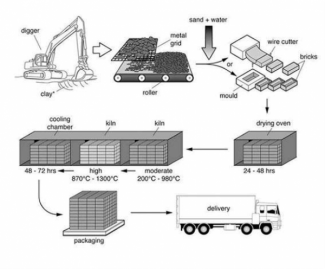
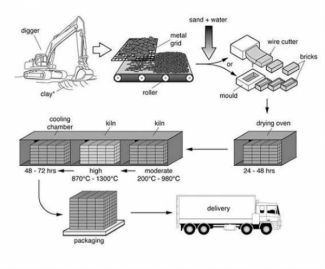
The flow chart describes how bricks are produced for and delivered to the building industry
There are seven main stages in the process of manufacturing bricks, beginning with an excavation of clay and tricks are transported at the end
The first stage in the process is digging clay up by a big digger. Then, to get rid of the oversized pieces, clay is placed on a metal grid and pieces in smaller size drop down onto a roller. Subsequently, sand and water are added to the clay. After bricks are shaped by a wire cutter or a mould, they are moved to a drying oven for 24 to 48 hours.
The process continues with bricks are fired in a special kiln at a moderate temperature (200oC – 980oC) then they are moved in another kiln with higher temperature (810oC – 1300oC). Before being packaged at the sixth stage, the bricks are treated in a cooking chamber in 48 to 72 hours. The process concludes after the bricks are delivered to customers.
Top answer
The flow chart depicts describes how bricks are produced for and delivered to the building industry (Missing punctuation) There are seven main stages in the process of manufacturing bricks, beginning with the an excavation of clay and tricks (wrong word) are transported at the end (Missing punctuation. Also the underlined is ungrammatical. ) The first stage in the process is using heavy equipment to dig up a deposit of clay.
- The flow chart depicts describes how bricks are produced for and delivered to the building industry (Missing punctuation) There are seven main stages in the process of manufacturing bricks, beginning with the an excavation of clay and tricks (wrong word) are transported at the end (Missing punctuation.
- Also the underlined is ungrammatical.
- ) The first stage in the process is using heavy equipment to dig up a deposit of clay.
- digging clay up by a big digger .
- Then, to get rid of the oversized pieces, clay is placed on a metal grid so that the smaller and pieces in smaller size drop down onto a roller.
Get the Weekly English Kit 📬
New words, one handy idiom, and a 2-minute quiz — delivered to your inbox to keep your streak alive.
The flow chart depicts describes how bricks are produced for and delivered to the building industry (Missing punctuation)
There are seven main stages in the process of manufacturing bricks, beginning with the an excavation of clay and
 0
0 Related Questions