
Could you help me improve my report, please?
This is my coursework and I did not get a good grade. I want to improve my writing skills, but the teacher just gave me a general feedback. So could you give me some advise and help me correct my grammar mistake? Thank you!
Students’ perceptions of Corporate Social Responsibility and how it affects their intentions to buy.
Introduction
Corporate social responsibility has been regard as an essential area in businesses since the term stakeholder, which can be affected by corporations’ activities, was introduced by the multinational company in the late 1960s (Kaur, 2013). For decades, scholars have been working on the relationship between business and society consistently, and the term CSR bring them huge inspirations in this field. CSR endows corporations with new obligation. Companies were reminded of their responsibility for the process of not only their own firm but also the whole society. By 2013, over 80 percent of the top-500 companies address CSR as a separate part on their website (Kaur, 2013). Increasingly, companies are willing to invest more in their CSR institution, aiming at improving communities’ development, meanwhile, their reputation can be strengthened, and the relationship between customers and business can be enhanced. Further, the company will gain more potential customers and more profit in return (Abdeen, Rajah, and Gaur, 2016)
Previously, scholars had many explanations toward the definition of CSR. Mcguire (1963 cited in Ramasamy and Yeung, 2009) demonstrate CSR is an expectation that a company should show particular responsibility to the society, extending their crude responsibilities, such as, economic and legal. Further, Davies (1973 cited in Ramasamy and Yeung, 2009) illustrate that CSR is the obligation that the company should accept beyond the law. Later, Carroll came up with a CSR pyramid, which is one of the most famous and acceptable depiction. According to the Carroll (1991), CSR can be divided into four categories—economic, legal, ethical, and philanthropic. Economic responsibility, regarding as the primary incentive and principle role for the corporation, locates at the bottom of the pyramid. Above that are legal accountability and ethical responsibility. The most top one is philanthropic responsibility, which is highly desired by society, expecting the company to be a good corporate citizen (Carroll, 1991 and 2016). This framework can be operationalised by many researchers also because it brought up new inspiration for the difference between CSR and philanthropy. Before that, these two terms can be used interchangeably to describe the relationship between company and society. However, Lin-Hi (2010 cited in Safwat, 2015) argues philanthropy can not express CSR thoroughly. Philanthropic responsibility is defined as the desire to advance the welfare of the society. In order to carry out this obligation, the company may need to engage in volunteer and public-spirited activities, participate in perfecting educational institution and help build a better community life (Lantos, 2001; cited in Erenerdogmus, Cobanoglu and Ogut 2014). However, regarding general CSR, the company should do much more beyond these.
Most previous studies were based on the experimental stage and a general background to investigate the definition and content of CSR and its connection with society. At present, studies care more about customers, including their awareness and buying habits. Therefore, the purpose of this study is to explore students’ attitudes towards corporate social responsibility and the relationship between students’ buying habits and their attention to philanthropy responsibility. Therefore, two research questions will be covered in this essay: (1) What are students’ attitudes towards CSR issues? (2) In what ways do students’ attitudes toward philanthropy responsibility affect their intentions to buy? This study can be an inspiration to corporations and businesses as it illustrates some comments of a sample group selected from the youngest autonomous consumers.
Method
The data and analysis were based on the results collected from the online questionnaire and the online group discussion. A sample of 1052 respondents from sophomore year in XJTLU business major participated in this survey, and the vast majority of them were Chinese, while around 3.2% were from other countries, such as Indonesian and South Korea. According to Ahrens (1950), questionnaire method can bring valuable and meaningful results. Teachers designed the questionnaire, which only contains Likert-scale questions, and the open issues in the online group discussion. Furthermore, these were built in a computer based way may in order to distribute questions and collect data in an easy way by using electronic statistical tools. Students as participants need to write an initial first post to answer the discussion question and reply at least three other students in their assigned study group after finishing the questionnaire. Quantitive data, showing in the form of numbers and percentages, was collecting from the results of the questionnaire by computing the average of the answers and the percentage of the participants, and the qualitative data was obtained from the assigned discussion group by reading various comments from different students.
Result and Discussion
Two charts below were made based on the results of two specific questions in the questionnaire.
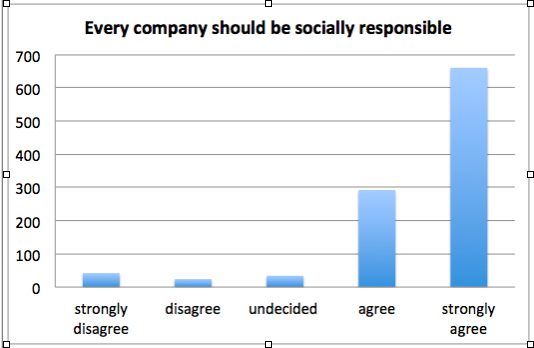
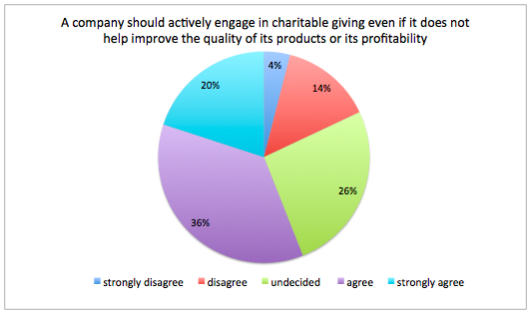
As shown in figure 1, over 60% of respondents strongly hold every corporation should be socially responsible, while the percentage of participants who chose uncertain and adverse terms only account for a small minority. It seems the result of the question whether a company should be social responsible lean to the agreement side. However, when adding the element of corporations’ profitability into the consideration, some students tends to change their mind. According to the pie chart, when considering both philanthropy and profitability of the corporation, there are only one in five respondents strongly agreeing the company still should actively engage in charitable giving even if it does not help improve the quality of its products or its profitability.
The dramatic decrease from 63% to 20% of the participants who strongly agree also support the opinion that people who approve company should be socially responsible also believe the quality of the production and profitability of the firm cannot be ignored even if engaging in charity is important. Misleadingly, as philanthropic responsibility lay at the top of Carroll’s CSR pyramid, some people may tend to believe it is the most vital and highly value area. For instance, Reidenbach and Robin (1991, cited in Schwartz and Carroll, 2003) indicate philanthropic responsibility is highly advanced, while economic responsibility is depicted as the least value stage since it is located at the bottom of the pyramid. However, Carroll’s primary intention is the more the responsibility close to the base, more crucial stage it shows, as it means philanthropic responsibility is less important than the other three stages (Reidenbach and Robin, 1991, cited in Schwartz and Carroll, 2003).
However, the decrease of the people who strongly agree does not mean this responsibility will not influence students buying habits and their impression towards the firm. Instead, the percentage of proponents in figure 2 still occupied over half of the total, and it indicates a majority of students do hold the philanthropy of the corporate will influence their intention to buy. The mainstream view from the discussion group also supports this indication. In the study group, most people hold philanthropy do impact people’s buying habits, and even if it would not determine their intention, it still influences their impression of the corporation and their loyalty. In another word, philanthropic records of the company will affect students’ buying intentions in an indirectly way.
Student A indicates that he inclines to purchase from the corporation which practices philanthropy in the case of choosing similar products from different companies, because he possibly believes firms need to repay the society and helps the vulnerable group if their businesses are very profitable. However, his further opinion shows companies will not be regarded as unethical if it does not engage in philanthropic activities. Carroll (1991) has mentioned philanthropy is discretionary and voluntary. Things that the community desires the company to do, such as, donate money and service to humanitarian progress, are not mandated and required by law (Carroll, 2016). Student B seems to agree, and she believes that it is acceptable that a corporation does not engage in philanthropic activities, but a better responsibility to customers will be shown if the company did that before and she is willing to pay extra money to such companies. Although her buying intention will not hundred percent depends on the corporation’s philanthropy, it still influences her loyalty. If a company have critical philanthropic records, such as lying about the number they donated or pocketing the money they raised, her loyalty is likely to be impacted negatively. That is possibly because these behaviors show the lack of responsibility to the public and the people they promised to help, and the companies like this will unlikely be answerable to customers, to some extend.
Conclusion and recommendation
The purpose of the study is to explore students awareness of CSR and to investigate whether their attitudes towards philanthropic responsibility will have an impact on their buying habits or not. In conclusion, most of the students hold the company should be socially responsible, and their intentions to buying will be influenced by company’s philanthropy. Students tend to show more loyalty to a company with better philanthropic records. In addition to the conclusion, the limitation of this study cannot be ignored. The most apparent problem of this survey is the boundary of the sample. Participants are all from business major, and their awareness of the CSR cannot represent all students since CSR is a common term in business class while many students from other major may never heard about it. Thus, in the future, if someone wants to do similar research, it is much more convincing and accurate to select a sample from different majors to avoid overgeneralization.
The finding of this study can bring some inspiration to business. Firstly, philanthropy is necessary to build a greater brand image. Even if students do not buy the product just depend on the company’s brand, it will still influence their impression and loyalty in the long term. Secondly, since a company decides to do philanthropy, it is severe to lie about the real donation because customers will regard this behavior as irresponsibility and tend to shift their choice when they find another similar company with a better public image.
Get the Weekly English Kit 📬
New words, one handy idiom, and a 2-minute quiz — delivered to your inbox to keep your streak alive.
 Related Questions