
0
Persian Learner Posted 10 years ago
Grammar
Compound vs Complete predicate
Hi.
1) The principal, the teachers, and the students wrote and produced the play.
2) Those two smiling men manufacture and sell false teeth.
My textbook, Let's Write English Book1 by George E. Wishon- page 4, labels the first sentence's predicate as compound and the other in the second one as complete. I really can't distinguish between them.
And here is the exact page:
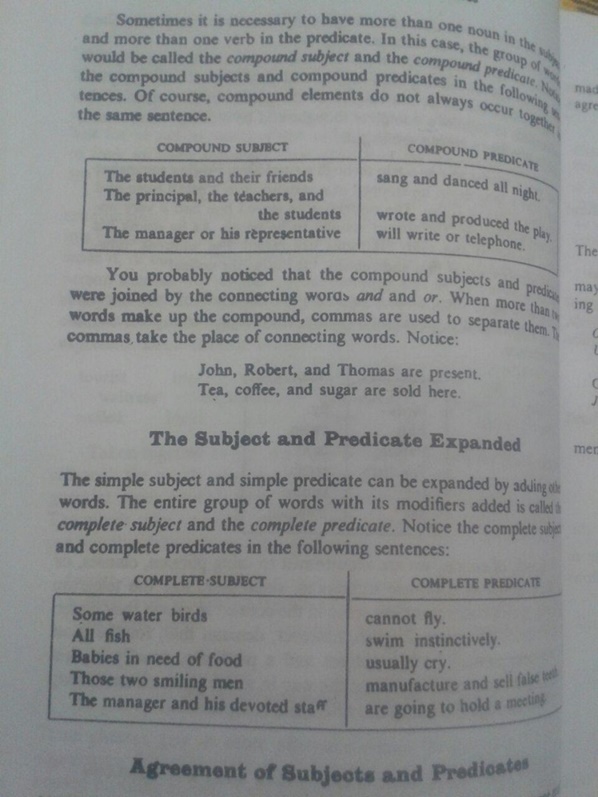
1) The principal, the teachers, and the students wrote and produced the play.
2) Those two smiling men manufacture and sell false teeth.
My textbook, Let's Write English Book1 by George E. Wishon- page 4, labels the first sentence's predicate as compound and the other in the second one as complete. I really can't distinguish between them.
And here is the exact page:
Top answer
You are right. That is a poor and confusing explanation that is wrong. In all the cases, you have complete, compound predicates.
- You are right.
- That is a poor and confusing explanation that is wrong.
- In all the cases, you have complete, compound predicates.
Get the Weekly English Kit 📬
New words, one handy idiom, and a 2-minute quiz — delivered to your inbox to keep your streak alive.
9 Answers
0
You are right. That is a poor and confusing explanation that is wrong. In all the cases, you have complete, compound predicates.
 0
00
So, do the both sentences I've mentioned have a compound predicate since there are two verbs separated by and?
00
Persian LearnerI really can't distinguish between them.That's because there is no syntactic difference between them. They have the same grammatical structure.
What you're supposed to be learning here is different ways of talking about subjects and predicates.
I can say that an elephant has a trunk. I can say that an elephant has a tail.
00
CalifJim'the English students and the German professors' is the complete subject.So what's the compound subject?
00
Persian LearnerSo what's the compound subject?'the English students and the German professors'
And the simple subjects are 'students' and 'professors'.
CJ
00
CalifJim'the English students and the German professors'So, you mean all compound subjects are at the same time complete subjects, but not all of the complete subjects are compound subjects, right?
00
Persian Learner CalifJim'the English students and the German professors'So, you mean all compound subjects are at the same time complete subjects, but not all of the complete subjects are compound subjects, right?What I've understood from the CJ's explanation is that "complete subject" is a syntactic function whereas "simple subject" and "compound subject" ar
00
Persian LearnerSo, you mean all compound subjects are at the same time complete subjects, but not all of the complete subjects are compound subjects, right?Yes, and as I showed you, you can also specifically pick out the two or more simple subjects from a complete compound subject, as when we say that the simple subjects within the complete compound su
00
Thank you very much indeed for your deep and understandable explanations, dear CJ. I wish you had written the book. 
0 Related Questions