
(12/9) please help me to check these two essays. Thank you!
Please help me to check and correct these two essays. I find it really hard to correct those mistakes by myself  Thank you!
Task 1: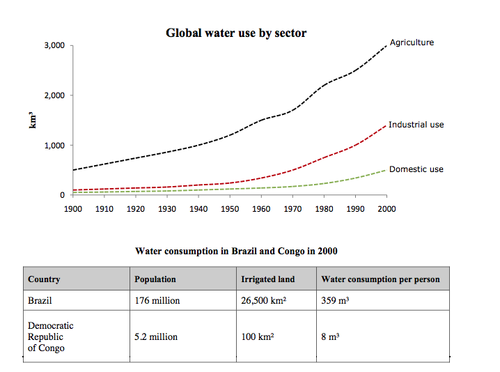
The line graph compares the amount of water used all over the world in 3 main sectors while the table illustrates the water consumption in 2 specific countries.
Overall, the global demand for water increased rapidly throughout a century from 1900 to 2000. The use of water in Brazil was much higher than that of Democratic Republic of Congo in 2000.
On 1900, a small amount of water was used for Domestic use and industrial use, which was much lower than that of agriculture taking at 500 km3. Over half of the century, the water use in all three fields witnessed a small increase to 50, 100 and 1000 km3 respectively. At the remaining of the period, there was a remarkable rise in water consumption. The amount of water used for argricutural purposes peaked at 3000 km3 while that for industrial and domestic use also reached the highest points at 1200 and 400 km3 in turns.
In the table, 359 km3 of water was consumed per person in Brazil, which was 50 times higher than the figure of Democratic Republic of Congo. This was due to the large area of irrigated land and the dense population in Brazil compared with the Democratic Republic of Congo.
Task 2: discuss both views and give your own opinions.
Some people think that universities should provide graduates with the knowledge and skills needed in the workplace. Others think that the true function of a university should be to give access to knowledge for its own sake, regardless of whether the course is useful to an employer.
After graduating from universities, students have to hunts for their own jobs in such a competitive labour market without any guidance. While there is an idea that universities should equip students with practical knowledge and skills necessary for their future career, some opponents argue that universities ought to deliver knowledge on their own curricula. In my viewpoint, both sides are reasonable but the former would bring more benefits to learners.
On the one hand, there are several undoubted advantages if undergraduates are taught according to the specific programs developed by their universities regardless of whether the course would be useful ore not for their job. First and foremost, because students are given knowledge in a diversity of fields, they would have their own larger source of knowledge apart from what is included in the major. As a consequence, when they complete the university program, there would be more job opportunities for them to choose as well as more appropriate fields to pursue. Second. A variety of subjects at universities are not only crucial for students’ career but also essential for them to be good citizens of their country. Educating potential citizens for the nation would be the most important factor contributing to its sustainable development in the long run.
On the other hand, providing students with imperative skills would have positive impacts on their career in the future. The first advantage of this trend is that this practical knowledge would be a good preparation for them to integrate into the labour environment which is totally different from the university environment. Therefore, they would not be put under pressure of the invisible factors around them such as the fear of their boss or the concern about unpleasant relationships with fellow-workers at the workplace. Another benefits is that the knowledge related to their future job is really helpful in the real life. Consequently, learning practical subjects like that would fulfil their flaws of social skills or behaviors, helping them to be perfect citizens of the country.
In conclusion, whatever sorts of knowledge students are provided, they all are needed for their life after leaving universities. However, I agree that the skills learned to serve for their profession would be applied much more frequently.
Top answer
Please post only ONE essay per thread. It is time-consuming to review and give comments on each essay.
- Please post only ONE essay per thread.
- It is time-consuming to review and give comments on each essay.
Get the Weekly English Kit 📬
New words, one handy idiom, and a 2-minute quiz — delivered to your inbox to keep your streak alive.
Please post only ONE essay per thread. It is time-consuming to review and give comments on each essay.
 0
0The line graph compares the amount of water used all over the world in 3 main sectors (which sectors?) while the table illustrates the water consumption in 2 specific countries. (Which ones?)
You should give more information in the first paragraph. Write more than one sentence. For example:
The line
0 Related Questions